A presence held in shadow
Wildlife | April 2026
There are moments in the bush where the landscape feels complete, yet something within it remains unresolved, as though a presence exists just beyond what can be seen, held not in movement, but in the quiet tension of awareness. It is often in these moments that the leopard is closest, not announced by sound or motion, but by a subtle shift in atmosphere that suggests it has already arrived.
To encounter a leopard is rarely direct. More often, it reveals itself in fragments — the curve of a tail draped over a branch, the outline of a body folded into the fork of a tree, or a brief, unmistakable gaze before it dissolves once more into cover. Its coat, marked with rosettes that echo the patterns of light and shadow around it, allows it to exist within the landscape rather than upon it, making distinction between animal and environment almost indistinguishable.
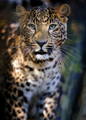
This ability to remain unseen is not incidental, but central to the leopard’s nature. Moving with a measured and deliberate rhythm, it expends no unnecessary energy, each step placed with precision, each pause considered. There is no urgency to its movement, only control, guided by an acute awareness of its surroundings. Even in open terrain, it carries with it a sense of concealment, as though the act of being visible is something it chooses, rather than something imposed upon it.
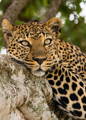
Across Africa, the leopard adapts to a wide range of environments, from dense woodland and riverine forest to rocky escarpments and open savannah. It moves between these spaces with ease, shaped not by a single habitat, but by its ability to respond to each one. Trees play a defining role within this relationship, offering both vantage and refuge. It is here that the leopard is most often found at rest, its body draped along a branch, suspended above the ground in a posture that appears both effortless and entirely secure.
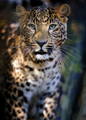
This elevation is not only a place of stillness, but of strategy. The leopard is an opportunistic hunter, relying on stealth rather than speed, approaching its prey with patience and precision before committing to the final movement. Once the hunt is complete, it will often carry its kill into the branches, lifting it beyond the reach of scavengers in a display of strength that is both functional and quietly remarkable. In this, the tree becomes an extension of the animal itself, part of the landscape through which it moves and survives.
There is a duality to the leopard that resists simple definition. It is at once visible and invisible, powerful yet restrained, present yet elusive. Its beauty is immediate, yet its nature reveals itself only over time, through observation and patience. It does not impose itself upon its environment, but exists within it with a balance that feels instinctive and complete.

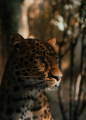
To watch a leopard is to understand the value of stillness, of allowing time for form to emerge rather than seeking to define it too quickly. Its movements are economical, its presence controlled, and within this restraint there is a clarity that feels both natural and deliberate. It is this understanding that continues to shape the way we observe the natural world, not as something to be captured in full, but as something to be approached with care and attention.
Within our own work, this way of seeing becomes part of the process, where observation precedes making, and where form is guided by what has been understood rather than what is assumed. The leopard, in its quiet precision, offers a reminder that presence does not require excess, and that what is held back often carries as much meaning as what is revealed.
Did you know?
01
Leopards are the most adaptable of the big cats, found across Africa and parts of Asia in a wide range of habitats.
02
They are capable of dragging prey heavier than themselves into trees to protect it from scavengers.
03
A leopard’s rosette pattern is unique to each individual, much like a fingerprint.
04
They are primarily nocturnal, relying on exceptional night vision to hunt in low light.
05
Leopards can leap over six metres horizontally and three metres vertically in a single bound.
For our family, the leopard represents a way of understanding the natural world that is rooted in patience and observation, where meaning is not immediately given, but revealed over time. It reflects an approach to both nature and craftsmanship that values restraint, balance and quiet precision, allowing each piece we create to carry something of that same presence, shaped not by excess, but by the clarity that comes from truly seeing.
Read more