Where stillness holds form
Wildlife | January 2026
At close range, the first impression is not movement, but mass — a presence that feels settled into the ground, as though shaped from it rather than moving across it. Dust gathers lightly around its feet, disturbed only in small increments as it shifts its weight, and the air carries a faint, dry scent of earth and skin warmed by the sun. The rhino does not arrive suddenly; it is simply there, revealed gradually as the eye adjusts to its form.
Its body is defined by structure rather than line, broad planes of muscle and bone carried beneath a surface that folds and creases like weathered terrain. The skin, thick and marked by time, holds a texture that seems to absorb light rather than reflect it, giving the animal a muted solidity that resists sharp definition. Nothing about it is decorative, yet every aspect of its form feels resolved, shaped through function and continuity rather than display.
When it moves, the rhythm is steady and unhurried, each step placed with a measured certainty that reflects both its weight and its awareness of the ground beneath it. The head is carried low, aligned with the forward motion of the body, giving its movement a grounded quality that feels deliberate rather than expressive. There is no excess in the way it moves, only a quiet progression that follows familiar paths worn into the landscape over time.
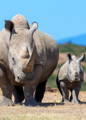
Despite its scale, there is a sensitivity to the way the rhino engages with its surroundings. Its eyesight remains limited, and so its understanding of the world is shaped through other means — the turn of an ear, the lift of the head as scent is drawn into the air, the subtle pause that suggests a shift in attention. It listens and senses rather than observes directly, allowing proximity and atmosphere to guide its awareness.
The environment responds to this presence in understated ways. Grass bends and recovers in its wake, pathways become more defined through repeated passage, and areas of mud and water take on a different texture where the animal has stood or rested. At waterholes, the rhino lingers with a quiet purpose, drinking slowly before settling into the shallows or along the edge, where mud is drawn across its skin in deliberate motions that serve both function and comfort.
This interaction with the land is continuous, not separate. Feeding, moving, resting — each action contributes to a pattern that becomes part of the terrain itself. There is no clear boundary between the animal and its environment, only an ongoing exchange that shapes both over time. The rhino does not alter the landscape dramatically, yet its presence is recorded in subtle, enduring ways.
There is a stillness to the rhino that extends beyond its physical form. It does not seek attention, nor does it withdraw entirely, existing instead within a space that feels self-contained and assured. Even in moments of alertness, where movement becomes more immediate and direction more defined, there remains a sense of control that never shifts into excess. Its strength is evident, yet never performed.

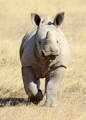
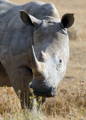
To observe a rhino in this way is to recognise the value of form that is guided by necessity, where structure carries meaning without requiring embellishment. The weight of the animal, the texture of its surface, the rhythm of its movement — each element reflects a clarity that emerges not from complexity, but from resolution over time.
Within our own work, this understanding of form remains closely tied to observation. The rhino does not present itself in parts, but as a complete presence, requiring attention to proportion, balance and surface as a whole. It is through this process of seeing, returning, and refining that a deeper understanding begins to emerge, one that allows the essence of the subject to be carried forward without excess.
Did you know?
01
Rhinos have relatively poor eyesight but highly developed senses of smell and hearing.
02
They use specific pathways repeatedly, creating well-defined tracks across their habitat.
03
Rhinos frequently wallow in mud, which helps regulate body temperature and protect their skin.
04
Their horns are made of keratin, the same material as human hair and nails.
05
A rhino can run at speeds of up to 50 kilometres per hour over short distances.
For our family, the rhino represents a way of understanding the natural world that is grounded in presence and form, where what is observed is allowed to speak without interruption. It reflects a connection to Africa that is shaped not by spectacle, but by time spent looking closely, allowing each encounter to build into something more considered, and carrying that understanding forward into the objects we create, where clarity, balance and restraint remain central to the process.
Read more